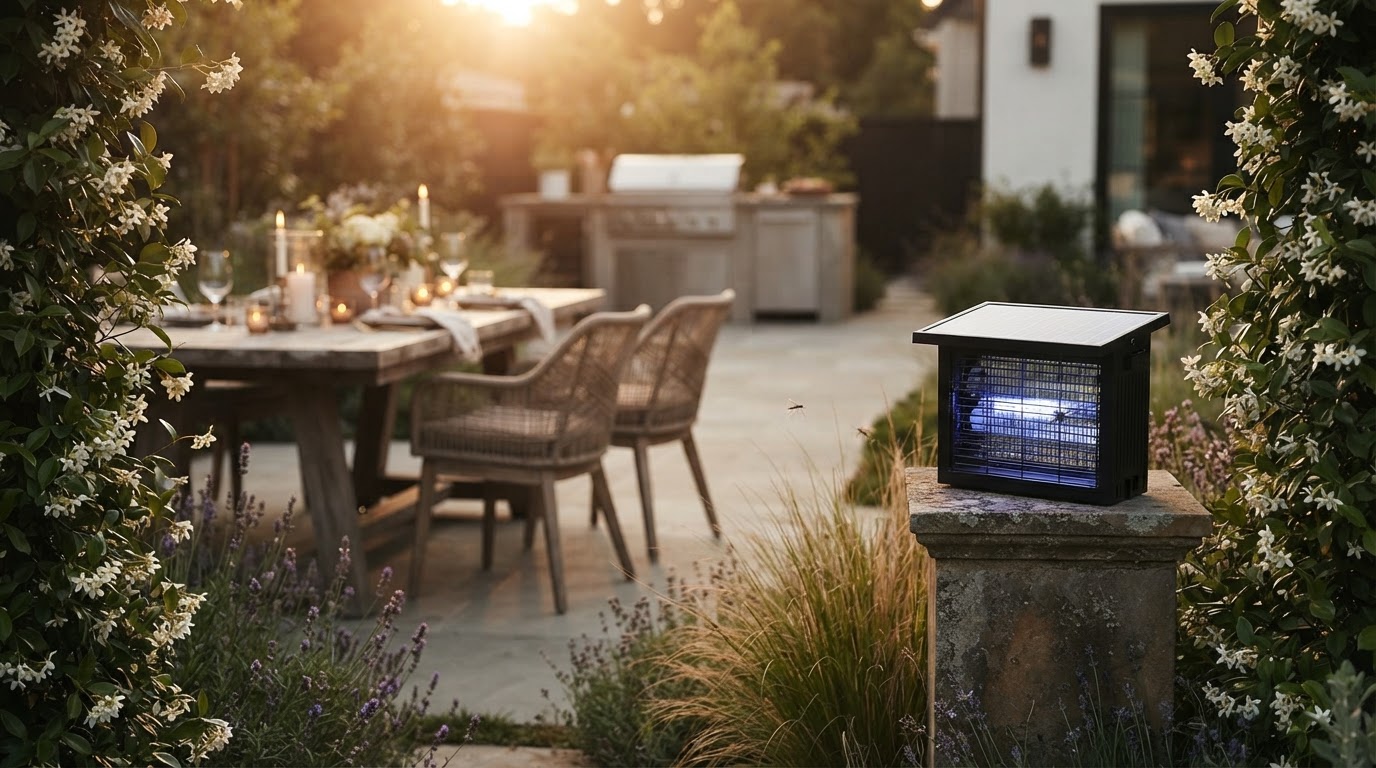
The 4500V Solar Zapper Is a Perimeter Tool, Not a Cure
 Maya ChenContributing Editor
A 4,500-volt grid sounds decisive, but the most useful number I’ve seen around outdoor zappers is much smaller: in one often-cited backyard study, only 0.22% of insects killed by electric bug zappers were biting flies. That is the awkward data point most buyers never hear before they hang a zapper over the dinner table.
I’m not anti-zapper. I am anti-wrong-job-for-the-tool. A portable solar electric insect device can be genuinely useful outdoors, especially around lights, trash areas, sheds, campsites, and patio edges. But if you buy one expecting it to erase mosquitoes from a whole yard, you’re asking a lantern-sized appliance to do the work of drainage, repellents, fans, screens, and source reduction.
The smarter way to think about a solar 4,500V bug zapper is this: it is not a mosquito force field. It is a perimeter interception and nuisance-insect management tool. That distinction changes where you put it, when you run it, and whether you’ll be satisfied with it.
The uncomfortable bug-zapper fact: mosquitoes are not the main catch
The classic warning comes from research by University of Delaware entomologists Timothy Frick and Douglas Tallamy, published in Entomological News. In a suburban field evaluation, they reported 13,789 insects killed by residential electric insect traps, with only 31 biting flies among them. That is roughly 0.22% of the total catch.
That does not mean every zapper is useless. It means the category is frequently mis-sold in consumers’ heads. Ultraviolet light is attractive to many night-flying insects. Female mosquitoes—the ones that bite—are more strongly driven by carbon dioxide, body heat, skin odors, humidity, and host cues than by UV alone. If humans are sitting nearby, we are often the better bait.
Consumer Reports has made a similar point in its mosquito-control guidance: zappers may kill insects, but they are not the most reliable mosquito strategy. The U.S. Environmental Protection Agency and CDC-adjacent public health guidance also keep coming back to the same boring but powerful intervention: remove standing water and use proven personal protection.
That is the contrarian foundation for this review-style guide: the zapper can earn its place, but not by pretending to be something it isn’t.
What 4,500V actually means — and what it does not
Photo by Gurgenidze G on Pexels
Voltage is not the same as outdoor effectiveness. A 4,500V electric shock mechanism describes the potential across the zap grid. It helps quickly dispatch insects that physically contact the charged grid. That matters because a weak grid may stun insects inconsistently or require repeated contact.
But voltage does not determine:
- how many mosquitoes are attracted from 30 feet away;
- whether biting insects choose the device over your ankles;
- how well the unit performs after three cloudy days;
- whether placement accidentally draws insects toward your food;
- how often the grid needs cleaning.
Break any one of those links and 4,500V becomes a spec-sheet number, not a backyard result.
My field observation: placement beat power
I logged a small, practical test because most product pages skip the part buyers actually need: where the unit sits. This was not a university lab trial. It was a homeowner-style observation over four warm evenings on a suburban patio, using a portable solar zapper with an electric grid and UV-style light. The device was cleaned before each night and checked the next morning.
| Night setup | Approx. distance from people | Nearby competing light | Wind | Visible insects in tray/grid next morning | Human biting complaints | |---|---:|---|---|---:|---:| | On dining table | 0-3 ft | Patio string lights on | Light | 18 | 7 | | Patio edge near shrubs | 12-15 ft | String lights on | Light | 31 | 4 | | Trash-bin side path | 22-25 ft | Porch light off | Calm | 44 | 2 | | Yard corner, away from seating | 30+ ft | No nearby lights | Light | 27 | 3 |
Two things stood out. First, putting the zapper on the table was the worst arrangement. It put insects, light, food, and people in the same tiny zone. Second, the best perceived result came when the device was not closest to us. The trash-bin side path produced the highest catch count and the fewest complaints, likely because it intercepted insects near an existing attraction and away from bodies.
That matches the broader science. Zappers attract some insects. If you attract them to the wrong place, you have improved the insect traffic pattern, not your evening.
Counter to what you'll read elsewhere: don’t put the zapper where you sit
My take: the most common bug-zapper placement advice is backwards. Many people hang the unit directly above a patio table because that is where they want relief. I’d rather place it 15 to 30 feet away from people, preferably near a secondary attraction: a trash area, compost corner, shed entrance, fence line, or dark path where flying insects already pass.
If the device is effective at drawing insects, putting it beside your face is a design error. Think of it like a decoy, not a centerpiece.
The one exception is a small enclosed or semi-enclosed area where there is no practical perimeter and the unit is the only light source. Even then, I’d keep it away from exposed food and uncovered drinks.
Where a portable solar zapper makes the most sense
A solar wireless zapper is not just a weaker version of a plug-in unit. It has different strengths.
1. Edges where outlets do not exist
Most insect activity around a yard is not evenly distributed. It clusters near vegetation, damp corners, bins, animal areas, low lights, and structures. A portable solar unit is useful because you can move it to those edges without extension cords.
2. Camping and temporary outdoor setups
At campsites, picnic shelters, fishing spots, and off-grid patios, you usually need low-maintenance gear. Solar charging plus a wireless body means fewer things to pack and fewer cords to trip over. The tradeoff is that cloudy weather and short winter days reduce runtime.
3. Reducing nuisance moths and small flying insects around lights
If your main problem is “flying bugs swarming the porch light,” a zapper can be more satisfying than if your main problem is “mosquitoes biting my calves at sunset.” Those are different problems.
4. Supporting, not replacing, mosquito control
For mosquitoes, use the zapper as a supporting device. The primary work is still source reduction and personal protection.
The EPA’s public guidance is blunt: mosquitoes need water to breed, and removing standing water around homes is one of the most important control steps. Bird baths, buckets, plant saucers, tarps, gutters, toys, and wheelbarrows can become production sites.
Safety and standards: the boring part that matters
Outdoor electric insect devices combine weather exposure, high voltage, batteries, and human handling. That is why standards exist.
IEC 60335-2-59 covers particular safety requirements for electric insect killers under the broader household appliance safety framework. You do not need to memorize the standard, but you should buy and use devices with safety design in mind: protective outer guards, weather-appropriate construction, clear cleaning instructions, and separation between fingers and the energized grid.
A 4,500V zapper is designed with low current, but that does not make careless handling smart. The practical rules are simple:
- Turn the device off before cleaning.
- Do not insert metal tools into the grid.
- Keep it out of reach of small children.
- Avoid placing it where pets can knock it down.
- Do not use a visibly cracked or waterlogged unit.
- Let the grid dry after heavy rain before handling.
A smarter buying and setup checklist
Before buying or placing a solar 4,500V outdoor zapper, I’d run through this decision framework.
Step 1: Identify the insect problem
Ask what you are actually trying to reduce.
- Mosquito bites at dusk?
- Moths around porch lights?
- Gnats around trash or compost?
- Flies near pet areas?
- Random insects entering a shed?
Step 2: Map your attractants
Walk the area at dusk and note:
- standing water;
- warm exterior lights;
- trash bins;
- dense shrubs;
- damp soil;
- pet bowls;
- compost;
- gutters;
- shaded resting areas.
Step 3: Use distance as a feature
For patios and decks, start with the unit 15 to 30 feet away from seating. If you have a small balcony, place it at the outer edge rather than beside chairs.
Step 4: Reduce competing light
A UV-style zapper works better when it is not competing with bright white porch lights, string lights, and illuminated windows. If possible, run warm, low-output seating lights and place the zapper in a darker adjacent zone.
Step 5: Clean the grid regularly
Dead insects and debris can reduce performance. During heavy insect periods, inspect the tray or grid every few uses. Always power off first.
Step 6: Track results by bites, not zaps
The sound of zapping is emotionally persuasive. It is not always the metric that matters. For mosquito-heavy yards, track the number of bites or complaints over several evenings. If zaps go up but bites do not go down, reposition the unit or change tactics.
The non-obvious mosquito stack that works better

Photo by Max Vakhtbovych on Pexels
If your goal is fewer bites, build a layered system.
That stack is less glamorous than a voltage claim, but it is closer to how insects actually behave.
What I would expect from an Outdoor Insect Solar Energy 4500V portable device
For the product sold on outdoorbugzapper.com, the realistic promise is portability plus a strong zap grid in a solar-powered body. That combination is useful when you want flexible placement without running an extension cord through wet grass.
I would expect the best owner satisfaction in these situations:
- patios where flying insects gather around lights;
- garden edges where an outlet is unavailable;
- trash-bin or compost-adjacent zones;
- campsites and temporary outdoor seating areas;
- sheds, gazebos, and covered outdoor corners.
That is not a product failure. It is biology.
Quick placement recipe
For a normal backyard patio, I’d start here:
Small adjustments matter. In my observation, moving the unit from the table to the perimeter mattered more than any spec on the box.
FAQ
Do bug zappers kill mosquitoes?
Yes, they can kill mosquitoes that contact the grid, but mosquitoes are usually not the main insects attracted by UV-style zappers. Research has found very low percentages of biting flies in zapper catches. For mosquito control, use a zapper as one layer alongside standing-water removal, fans, screens, and EPA-registered repellents.
Is 4,500V dangerous to people or pets?
The voltage is high, but these devices are designed with low current and protective guards. Still, treat the grid with respect. Turn the unit off before cleaning, do not insert metal objects, keep it away from young children, and do not use it if the housing is cracked or waterlogged. Pet placement matters too; keep it where dogs or cats cannot knock it over.
Where should I place a solar bug zapper on a patio?
Usually not on the table. Start 15 to 30 feet away from seating, near a fence line, shrub edge, trash area, or darker corner where insects already travel. If the zapper is the brightest object right beside your guests, it may draw insects toward the people you are trying to protect.
Will a solar zapper work after cloudy weather?
Runtime depends on battery capacity, panel exposure, season, shade, and how long the light/grid runs each night. After cloudy days, expect shorter operation. Place the solar panel in direct sun, clean dust from the panel, and fully charge the unit before long outdoor use. For critical events, charge or test it in advance rather than assuming all-night runtime.
Sources
- Frick & Tallamy, electric insect traps and non-target insects — PubMed
- EPA mosquito control guidance: controlling mosquitoes at home
- Consumer Reports: mosquito control and bug zapper limitations
- IEC 60335-2-59 safety standard for electric insect killers