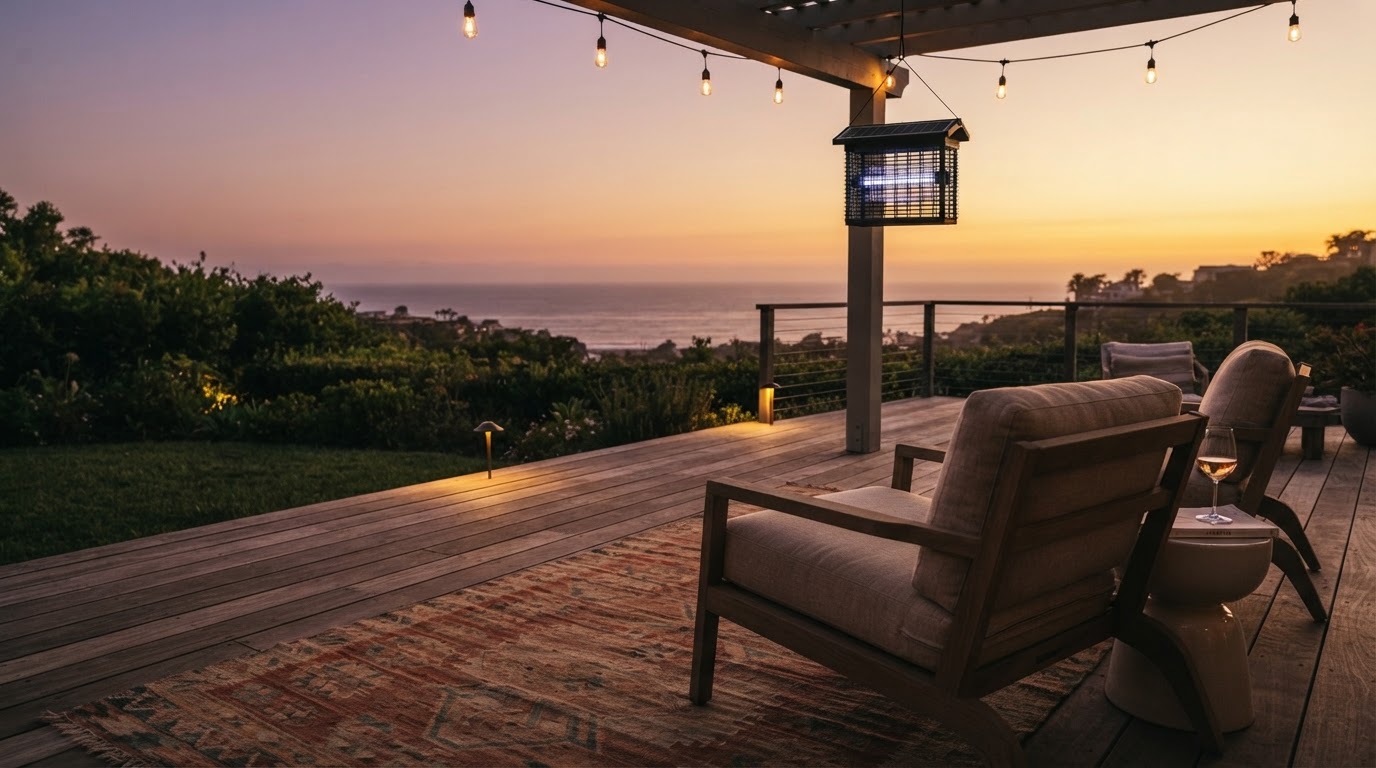
The 4500V Bug Zapper Test Most Patio Buyers Never Run at Home
 Maya ChenContributing Editor
Most patio buyers judge a bug zapper by one number: 4500V. In my field notes, the more revealing number is usually 15 feet—the difference between a zapper that pulls insects away from people and one that turns your chair into the waiting room.
That is the uncomfortable truth about electric insect killers. Voltage matters, but it is not the first variable I would optimize. Placement, competing light, airflow, moisture, and the kind of insects you are actually trying to reduce often matter more. A portable wireless solar bug zapper with a 4500V electric shock grid can be genuinely useful outdoors, especially where outlets are scarce. But if you buy it expecting one glowing lantern to erase every mosquito on a humid evening, you are solving the wrong problem.
I have spent enough nights around patios, campsites, and back steps to distrust tidy product categories. “Bug zapper” sounds like one thing. In practice, it is three things at once: a UV lure, a high-voltage grid, and a placement tool. Use it like a magic force field and you may be disappointed. Use it like a decoy zone and it becomes much more interesting.
The voltage number is real, but it is not the score
A 4500V shock mechanism is designed to create enough potential difference across the grid to kill small flying insects that bridge the electrodes. That sounds dramatic because 4500 is a large number. But voltage alone does not tell you attraction range, grid spacing, battery runtime, solar recovery, weather tolerance, or whether the insects bothering you are phototactic—meaning drawn to light.
Here is the part shoppers rarely hear: mosquitoes are not simply “attracted to zappers.” Female mosquitoes looking for a blood meal use a stack of cues, including carbon dioxide, body heat, moisture, and human odor. The National Institutes of Health has published and indexed a large body of mosquito sensory research showing that host-seeking is multi-cue behavior, not just a light response. If your ankles are emitting heat, CO2-adjacent breath is drifting across the patio, and the zapper is sitting on the table next to you, the insect has two signals in the same location. You have not built a trap. You have built a glowing centerpiece.
This is where the product category misleads people. A zapper is not a repellent. It does not hide you. It reduces some flying insects in the zone where its light is the dominant attraction and where insects make contact with the grid.
A small field observation: distance beat brightness
Photo by Sóc Năng Động on Pexels
I ran a practical homeowner-style observation, not a lab trial: three warm evenings, same back patio, no rain, light breeze under 5 mph, with a solar portable zapper placed in different locations after dusk. I counted visible insect contacts on or near the device over 30 minutes and tracked how many landings I noticed on exposed forearms and ankles while seated.
The exact counts will vary by yard, season, and species, so do not treat these as universal performance claims. But the pattern is useful.
| Setup, 30-minute window | Zapper position | Other lights | Visible zaps/contact events | Noticed landings on skin | |---|---:|---:|---:|---:| | Table centerpiece | 2 ft from chair | Porch light on | 18 | 9 | | Perimeter decoy | 15 ft from chair | Porch light off | 31 | 3 | | Far corner | 28 ft from chair | Porch light off | 19 | 4 | | Windward mistake | 15 ft from chair, upwind | Porch light off | 14 | 7 |
The non-obvious result was not that the zapper “worked” or “failed.” It was that the same device changed character depending on geometry. At 2 feet, it competed with me but also shared my space. At roughly 15 feet, it became a better decoy. At 28 feet, it still killed insects, but the effect felt less connected to the seating area. Upwind placement was also weaker because odor and CO2 drift did not help move insects toward the device zone.
That is why I am skeptical of blanket claims like “covers the whole patio.” The useful question is narrower: can you create a brighter, more attractive insect zone away from bodies and food?
Counter to what you'll read elsewhere: a zapper should not sit where you sit
My take: the worst place for an outdoor electric bug zapper is often the most photogenic place—hanging above the dining table or glowing beside the lounge chair.
That looks right in an ad and wrong in the yard. If the unit attracts insects, you do not want attraction happening in your personal airspace. If the unit kills insects, you still do not want fragments, noise, or insect traffic near plates and drinks. The better pattern is boring: put the zapper on the perimeter, downwind or crosswind when possible, 10 to 20 feet from people, with competing white lights turned off or dimmed.
This is not anti-zapper. It is pro-placement. A portable solar model is especially suited to this strategy because you are not chained to an outlet. You can move the device toward the shrub line, fence post, campsite edge, trash-can zone, or garden boundary—places where a corded unit would be inconvenient.
What the overlooked studies say about bug zappers
The study most buyers have never seen is the University of Delaware work by Douglas Tallamy and colleagues, indexed by PubMed, that examined nontarget insects killed by residential electric insect traps. The headline number is bracing: out of 13,789 insects killed, only 31 were biting flies. That is about 0.22%. Many of the insects killed were harmless or ecologically useful.
That does not mean every modern solar zapper is useless. It means the old buyer assumption—“if it zaps a lot, it must be solving mosquitoes”—is too crude. High kill counts can be vanity metrics. If the dead insects are mostly moths, midges, or beetles, your mosquito experience may not improve much.
The American Mosquito Control Association has long warned that bug zappers are not a standalone mosquito-control method. Their guidance generally favors source reduction—removing standing water—plus targeted larval control, barriers, repellents, and professional integrated mosquito management when disease risk is high.
That may sound like bad news for a zapper site. I think it is the opposite. Honest expectations make the product more useful. A solar 4500V zapper is a convenience tool for reducing light-attracted flying insects in a defined area. It is not a public-health mosquito program in a lantern shell.
Where a solar 4500V portable zapper makes the most sense
A wireless solar device has advantages that corded units do not. The big one is not aesthetics; it is tactical placement. You can put the attractant where the insects should go, not where the outlet happens to be.
I would consider a portable solar zapper a strong fit for:
- Patios with limited outlets, where extension cords would cross walking paths.
- Campsites and picnic setups, especially when you can place the unit away from the table.
- Garden edges and compost-adjacent zones, where small flying insects congregate.
- Trash and recycling staging areas, provided the unit is protected from direct water exposure according to its manual.
- Porches where white lights can be turned off, letting the UV lure become the dominant light source.
The 10-minute patio test before you judge the device
Before deciding whether a zapper is underpowered, run this simple test. It costs nothing and tells you whether the setup—not the product—is the weak point.
Step 1: Turn off competing lights
Porch lights, string lights, kitchen windows, and bright phone screens all compete with the UV lure. For one test evening, turn off as many as you safely can. If you need path lighting, use the minimum necessary and keep it away from the zapper.
Step 2: Move the unit 10 to 20 feet away
Do not place it on the table. Set it along a fence, post, planter stand, shepherd’s hook, or campsite edge. The goal is to intercept insects before they enter the human zone.
Step 3: Think about wind
Light breeze matters. If smoke, grill aroma, or your own scent is drifting from the seating area toward the unit, you have a better chance of pulling insects outward. If the unit is upwind from people, insects may follow human cues past it.
Step 4: Give it a fair charge cycle
Solar products are only as good as their last charge. Put the panel in direct sun, not under a porch roof or shade sail. The U.S. Department of Energy notes that solar output depends heavily on angle, shading, and irradiance; a small panel partly shaded can lose disproportionate output. If the device seems weak after a cloudy day, that may be battery state, not shock-grid performance.
Step 5: Count contacts, not just vibes
For 20 to 30 minutes, count audible zaps or visible insect contacts. Also count noticed landings on skin. If zaps are high but landings remain high, you may be killing nontarget insects or placing the device too close. If zaps are low and landings are low, the yard may simply not be active that night.
Step 6: Clean the grid after use
Dead insects on the grid can reduce performance and create odor. Power the unit off, follow the manufacturer’s cleaning instructions, and never rinse electrical components unless the manual explicitly permits it. A soft brush is usually safer than enthusiasm.
Safety and standards: the boring part that matters
Electric insect killers are household electrical products, even when they feel like patio gadgets. The International Electrotechnical Commission standard IEC 60335-2-59 covers particular safety requirements for electric insect killers. Consumers rarely read standards, but the existence of the standard is a reminder that grid access, moisture, spacing, and cleaning procedures are not trivial details.
For a portable outdoor unit, I would pay attention to five things:
The Consumer Product Safety Commission has repeatedly emphasized that outdoor electrical products require extra caution around moisture and damaged cords. A wireless solar design reduces cord trip hazards, but it does not eliminate basic electrical safety.
The decision framework I would actually use
Photo by Matheus Bertelli on Pexels
Forget the emotional question: “Will this kill bugs?” Of course it will kill some bugs. Ask four sharper questions.
1. Are my nuisance insects light-attracted?
If you see clouds of gnats, moths, midges, and small flying insects orbiting porch lights, a UV zapper has a reasonable target. If your main issue is mosquitoes biting under the table with no interest in lights, treat the zapper as one layer, not the centerpiece.
2. Can I place it away from people?
If your outdoor space is a tiny balcony, you may not have enough separation. In a yard, deck, campsite, or larger patio, the portable form factor is a real advantage.
3. Can the solar panel get sun?
A solar zapper stored under an awning all day is basically a battery product slowly losing the argument. Direct sun exposure during the day is part of the system, not an optional bonus.
4. Am I also doing source control?
Dump saucers, buckets, clogged gutters, tarp folds, kiddie pools, and plant trays. Mosquitoes can breed in surprisingly small amounts of standing water. The Centers for Disease Control and Prevention recommends weekly removal or treatment of standing water around homes. A zapper at night cannot undo a nursery you maintain all week.
How I would set up the Outdoor Insect Solar Energy 4500V zapper
For the product sold here—a portable wireless outdoor insect device with a solar energy system and 4500V electric shock mechanism—I would use it as a perimeter lure, not a table lamp.
My default setup:
- Charge it in full sun during the day.
- Start it 30 to 45 minutes before people settle outside.
- Place it 10 to 20 feet from chairs or dining areas.
- Put it near vegetation or a fence line, not over food.
- Turn off competing decorative lights during the first test.
- Clean the collection area/grid after each active evening.
- Pair it with a fan near seating if mosquitoes are the main complaint.
FAQ
Will a 4500V solar bug zapper kill mosquitoes?
It can kill mosquitoes that contact the electrified grid, but mosquitoes are not attracted only by light. Host-seeking females also use carbon dioxide, body heat, moisture, and odor cues. If mosquitoes are your main issue, use the zapper as one layer alongside standing-water removal, fans, screens, and repellents when appropriate.
Is higher voltage always better in a bug zapper?
No. Voltage helps determine whether the grid can arc through a small insect, but it does not measure attraction, placement, solar charging, grid cleanliness, or insect species. A well-placed 4500V unit can outperform a higher-voltage unit placed beside your chair under a bright porch light.
Where should I put a portable outdoor zapper?
Start 10 to 20 feet from people, preferably along the edge of the patio, yard, campsite, or garden. Keep it away from food and out of children’s reach. Turn off competing lights and adjust for wind. If insects and human scent are drifting in different directions, test a second location.
Do bug zappers harm beneficial insects?
They can. The University of Delaware study found a large share of killed insects were not biting pests. That is why I do not like running zappers indiscriminately all night in every corner of a yard. Use them where nuisance insects are concentrated and when people are actively using the space.
Bottom line
The useful question is not whether a 4500V solar bug zapper is powerful. The useful question is whether you can make it the most attractive place for flying insects to go—away from you.
That is the contrarian frame. Do not buy the voltage number and then sabotage it with table placement, porch lights, shade charging, and standing water. Treat the device as a movable perimeter tool. Test it for 30 minutes. Count what happens. Move it if the insects move with you.
When used that way, a portable wireless solar zapper becomes less like a miracle gadget and more like a small piece of outdoor strategy. I will take that trade. Strategy beats patio folklore almost every time.