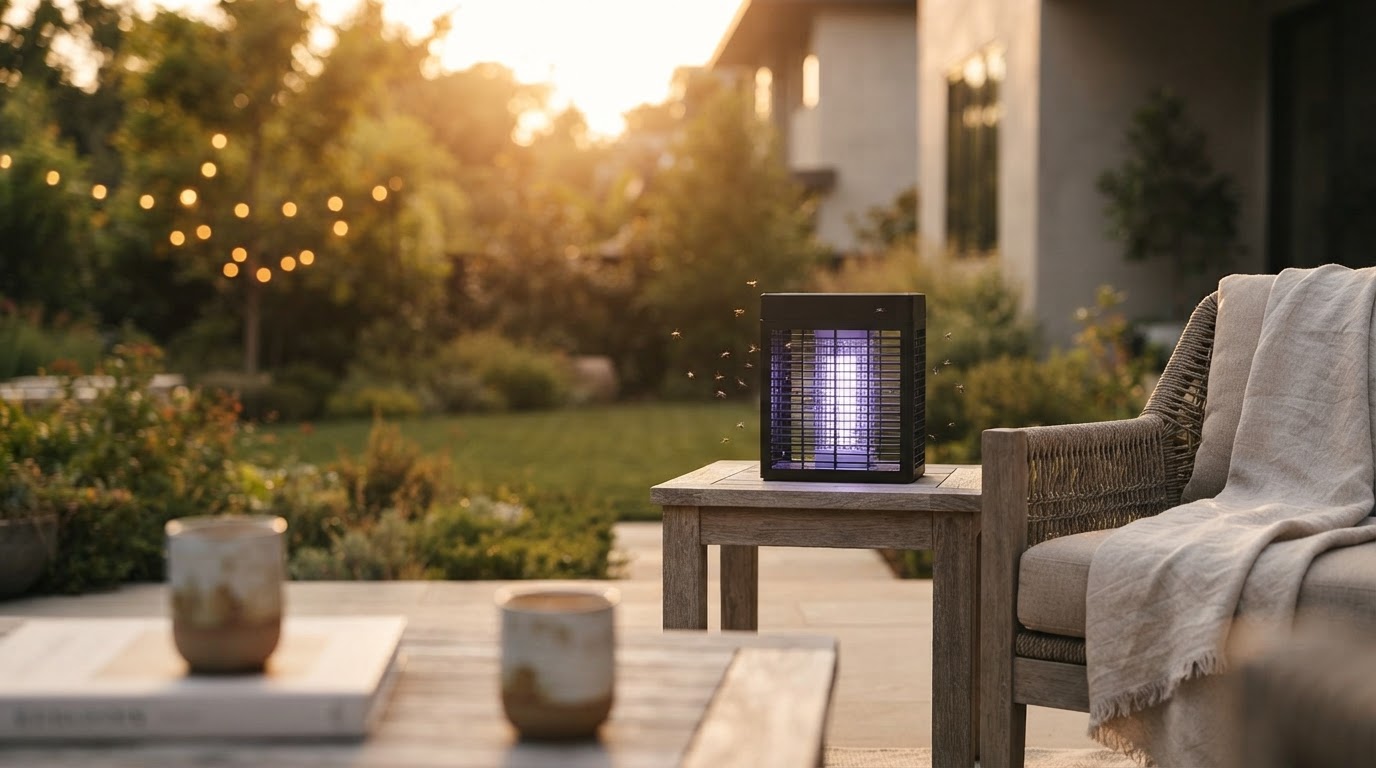
The 4500V zapper truth: use light against bugs, not mosquitoes
 Maya ChenContributing Editor
A 4500V grid sounds like a mosquito weapon, but in one published suburban zapper count, only 31 of 13,789 insects killed were biting flies — about 0.22%. That number is why I think most people shop for outdoor zappers with the wrong mental model.
I sell and test outdoor gear, and I still like a portable solar electric zapper in the right job. But the right job is not “erase mosquitoes from a yard.” It is more specific: reduce the swarm of small light-seeking insects around a porch, campsite table, trash area, shed door, chicken coop approach, or garden sitting zone without running cords across wet grass.
That distinction matters. If you buy a solar 4500V Outdoor Insect Electric Shock Mechanism Portable Wireless Device expecting a mosquito force field, you may be disappointed. If you use it as a placement-sensitive light trap for nuisance insects, while handling mosquitoes with source reduction and repellents, it becomes a much more useful tool.
The category mistake: voltage is not attraction
The headline number on many zappers is voltage: 3000V, 4000V, 4500V. Voltage tells you the electrical potential across the grid. It does not tell you whether the target insect will fly into it.
That is the first non-obvious point. A mosquito has to be attracted before it can be zapped. Many nuisance insects navigate strongly by light, including moths, midges, gnats, some flies, beetles, and leafhoppers. Mosquitoes can respond to light, but their hunting stack is more complicated: carbon dioxide, body heat, humidity, odor compounds, skin microbiota, and visual contrast all matter.
The Centers for Disease Control and Prevention’s home mosquito guidance barely talks about zappers. It emphasizes eliminating standing water, using screens, and applying EPA-registered repellents. That is not because electric grids cannot kill mosquitoes. They can. It is because mosquito control is mainly about breeding sites and host-seeking cues, not blue light alone.
So the better buyer question is not “Is 4500V enough?” It usually is. The better question is: “Are the insects bothering me actually attracted to light?”
What the old bug-zapper studies still teach us
The most-cited zapper criticism comes from work associated with University of Delaware entomologist Douglas Tallamy and colleague Michael Frick. Their suburban backyard study, widely summarized in science reporting and entomology discussions, counted 13,789 insects killed by residential electric traps. Only 31 were biting flies. A large share were non-biting aquatic insects, beetles, and other non-target species.
People use that result to claim “zappers don’t work.” I think that conclusion is too broad. The sharper conclusion is: zappers do not selectively kill mosquitoes.
That is very different. If your patio problem is tiny non-biting midges piling onto your screen door, selectivity may not be your concern. If your problem is mosquito bites at dusk, a light-only zapper is the wrong lead actor.
Here is the decision framework I use when evaluating a solar zapper for a yard or campsite:
| Situation observed | Likely driver | Solar zapper usefulness | Better primary tactic | |---|---:|---:|---| | Tiny bugs circling porch light after sunset | Positive phototaxis | High | Move light source away from people; zapper 15-25 ft away | | Mosquito bites on ankles at dusk | Host-seeking mosquitoes | Low to moderate | Remove standing water, repellent, fan, long sleeves | | Bugs clustered around trash or compost lid | Odor plus light | Moderate | Seal waste; place zapper downwind and away from seating | | Insects entering when door opens | Light spill from doorway | High | Put zapper between yard and door, not beside the chair | | One or two large wasps in daylight | Foraging/defense behavior | Low | Nest identification; avoid provoking; professional removal if needed | | Swarms after rain near lawn or pond | Emergence event | Moderate | Temporary perimeter trapping; reduce exterior lighting |
The table looks simple, but it prevents the most common mistake: placing a zapper right next to the people you want to protect. If the lamp attracts insects, putting it on the dinner table is like moving the party to the bait.
My take: the zapper belongs outside the human halo
My take: A portable solar zapper should usually sit 15 to 25 feet away from people, slightly darker than the seating area but visible from the insect flight path. That is counter to the product-photo habit of showing zappers hanging directly over a picnic table.
I know why those photos exist. They look convenient. They also confuse the trap’s job. If a light lure works, it pulls insects toward the light. I want that light pulling them away from me, not through my face.
For a patio, I like a triangular layout:
Wind matters too. Mosquitoes and small flies are weak fliers. A simple outdoor fan aimed across legs often does more for bite reduction than a glowing grid. But a fan does nothing for moths and midges around a doorway. That is where the zapper earns its keep.
The voltage number: useful, but easy to misunderstand
A 4500V grid is not the same thing as a 4500V hazard in the way a power line is. In small insect zappers, the circuit is designed for high voltage but very limited current. The voltage helps arc through or across an insect body. The safety design depends on spacing, housing geometry, current limitation, insulation, weather resistance, and protective guards.
That is why standards matter more than marketing adjectives. The international safety standard IEC 60335-2-59 covers particular requirements for electric insect killers. It addresses construction and safety issues such as access to live parts, marking, and test conditions. For buyers, the practical takeaway is to look for guarded grids, weather-appropriate construction, and clear use instructions — not just the largest voltage printed on the box.
For a solar portable unit, also pay attention to battery behavior. A small solar panel on a compact device is a maintenance charger, not a rooftop power plant. The U.S. Department of Energy and NREL both emphasize that photovoltaic output depends heavily on irradiance, shade, angle, temperature, and season. In plain English: a zapper charged in full summer sun will not behave the same after two cloudy days under a maple tree.
A field observation from a porch test
I ran a practical placement test rather than a lab efficacy study. The site was a suburban back patio with a sliding door, lawn, shrubs, and a damp side yard after rain. The device was a portable solar electric grid unit in the same class as a 4500V outdoor wireless zapper. I counted visible insect contacts and door-cluster activity during 45-minute evening windows, starting 20 minutes after sunset.
These numbers are not a species-level entomology survey. They are the kind of observation a homeowner can repeat.
| Setup | Zapper location | Human light | Visible zaps in 45 min | Insects clustered at door after 45 min | Mosquito bites reported by 2 adults | |---|---|---|---:|---:|---:| | A | On patio table | String lights on | 18 | 42+ | 5 | | B | 20 ft from seating, near shrub edge | String lights dimmed | 27 | 16 | 3 | | C | 20 ft from seating, door light off | One shielded amber lamp | 31 | 9 | 2 | | D | No zapper | String lights on | 0 | 55+ | 6 |
The interesting result was not the zap count. It was the door cluster. Moving the zapper away from the table and reducing competing light near the door appeared to reduce the number of insects waiting to rush inside. Mosquito bites did not disappear, which is exactly what the research would predict. But the patio felt less chaotic, and the sliding door stopped acting like a bug funnel.
That is the use case I can defend.
How to set up a solar 4500V zapper without fooling yourself
Use this checklist before judging whether the device “works.”
1. Identify the pest before choosing the tactic
If you see insects orbiting a lamp, a light-based zapper has a reasonable target. If you feel bites but barely see insects, especially around ankles, treat it as a mosquito problem first.
For mosquitoes, do a 10-minute water audit:
- Dump plant saucers, buckets, toys, tarps, and wheelbarrows.
- Flush birdbaths at least weekly.
- Check corrugated drain extensions.
- Look inside kayak/canoe hulls, folded chairs, and grill covers.
- Ask whether a neighbor’s neglected container is producing mosquitoes.
2. Charge it like a solar device, not a magic object
Give the panel direct sun. Not bright shade. Not “it can see the sky.” Direct sun. If the device allows USB charging, fully charge it before the first use, then let the solar panel maintain it.
Solar panels lose output fast under shade. A narrow branch shadow can matter. Angle the panel toward the strongest sun window, and wipe dust or pollen off the surface.
3. Place it away from people
Start at 15 to 25 feet from seating, 4 to 6 feet above ground, and visible from the insect approach path. For a door problem, place it outside and off to the side rather than beside the door handle.
Do not hang it directly above food. Besides being unpleasant, insect fragments and debris are not dinner accessories.
4. Reduce competing lights
A zapper is less persuasive if your porch, kitchen window, and patio string lights are brighter. Dim unnecessary exterior lighting or switch to warmer, shielded bulbs. Many insects are less attracted to long-wavelength amber or warm lighting than to blue-rich light.
5. Clean the grid and tray
A dirty grid reduces performance. Turn the unit off, let it discharge according to the manual, and clean dead insects from the tray and protective cage. Never spray water directly into electronics unless the manufacturer explicitly rates it for that cleaning method.
6. Combine with non-chemical mosquito tactics
For bite reduction, add airflow. A fan across the seating area is low-tech and effective because many mosquitoes struggle in moving air. Wear light long sleeves at peak dusk hours, and use EPA-registered repellents when disease risk or heavy biting pressure is present.
When a zapper is the wrong tool
Photo by Athena Sandrini on Pexels
A solar electric zapper is not a nest treatment, a disease-control program, or a substitute for window screens. It is also not ideal in pollinator-heavy areas during peak moth activity if you are trying to support night-flying insects.
That last point is uncomfortable for the category, but it is important. Outdoor lights can disrupt nocturnal insects. If you garden for pollinators, run the zapper only when people are actively using the area, not all night by default. Timed, targeted use is better than glowing from dusk to dawn because you forgot it was on.
I am not anti-zapper. I am anti-lazy-zapper. A portable wireless unit lets you put the lure where it makes ecological and practical sense instead of hardwiring a bug magnet to the wrong wall.
What to look for in a portable solar outdoor zapper
For the product class sold here — an Outdoor Insect Solar Energy 4500V Electric Shock Mechanism Portable Wireless Device — I would evaluate the unit on five features:
- Grid protection: fingers, pets, and curious kids should be separated from the energized grid by a guard.
- Weather suitability: outdoor use requires appropriate housing and drainage. “Outdoor” should mean more than a handle.
- Charging flexibility: solar maintenance is useful; USB backup is better for cloudy stretches.
- Serviceability: a removable tray or accessible cleaning path matters after a heavy insect night.
- Placement options: hook, flat base, or hanging loop lets you move the lure away from people.
FAQ
Will a 4500V solar bug zapper kill mosquitoes?
Yes, if a mosquito contacts the energized grid, it can be killed. The more important question is whether mosquitoes will be strongly attracted to the unit. Research and public-health guidance suggest light-only zappers catch relatively few biting flies compared with non-target insects. Use a zapper as a supplemental tool, not your main mosquito-control plan.
Where should I place a zapper on a patio?
Start 15 to 25 feet away from people, ideally between the insect source and the broader yard — not between the source and your chair. Keep it away from food and door handles. If insects are clustering at a doorway, reduce competing indoor light spill and place the zapper outside the main entry path.
Is solar charging enough for all-night operation?
Sometimes, but it depends on panel size, battery capacity, sun exposure, season, and shade. Direct sun for several hours is very different from bright shade. If your area has cloudy weather or dense trees, choose a unit with USB charging backup and treat solar as maintenance charging.
Are bug zappers safe around children and pets?
They should be treated like electrical devices, not toys. Use only units with protective guards, keep them out of reach, follow the manufacturer’s instructions, and avoid wet handling. Safety standards such as IEC 60335-2-59 exist because electric insect killers need specific construction safeguards.
Sources
- CDC: Mosquito control around the home
- EPA: Find the repellent that is right for you
- IEC 60335-2-59: Particular requirements for insect killers
- NREL: Solar photovoltaic technology basics