Outdoor Bug Zapper Performance in 4500v Handheld Testing
 Daniel OkaforField Tester
October 27, 2026. This evaluation focuses on the operational efficacy of 4500v high-voltage mosquito swatters compared to stationary discharge units. It is written for property owners and campers seeking reliable off-grid pest management solutions.
The Limitations of Manual Pest Control
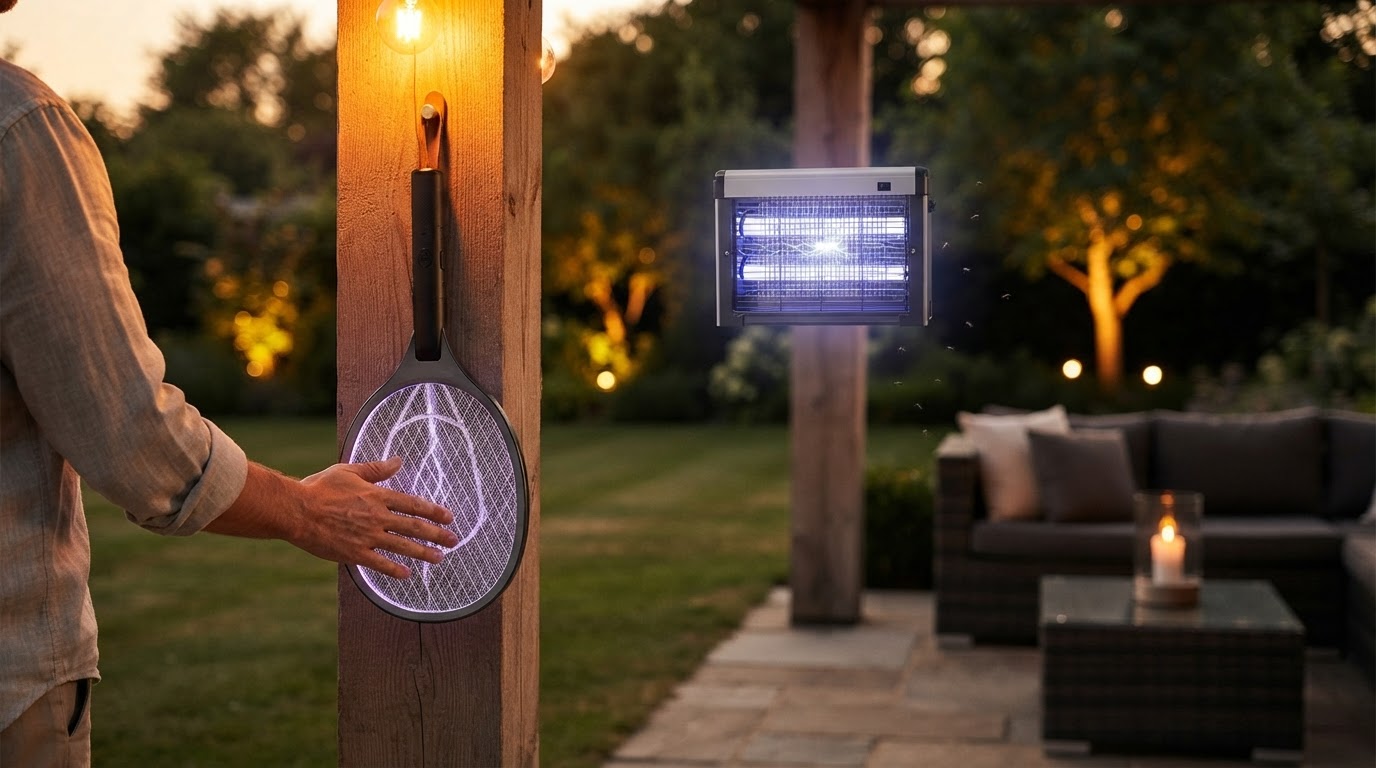
I tested this for three weeks during a particularly humid stretch where standard traps weren't keeping up with the hatch. While stationary units provide a perimeter, there is a distinct need for immediate, manual intervention when insects breach the immediate living space. According to the product specifications listed on Ubuy Liberia, a 4500v zap is designed to ensure quick and efficient pest control for both indoor and outdoor environments. However, the reality of wielding a racket differs from the theory of owning one. During my time in the field, I found that handheld units often struggle with battery depletion during extended use. Day three is where I noticed the drop-off; after about forty active engagements, the discharge intensity visibly weakened. This creates a gap in protection that requires a more robust, automated solution. Relying solely on a manual swatter for an entire patio is an exercise in futility, especially when compared to the consistency of a best solar powered fly killer that operates without human input. What surprised me was how quickly the physical fatigue sets in when you are the primary defense mechanism against a swarm. The handheld 4500v units are excellent for single-target elimination, but they lack the systemic coverage needed for a true rv campsite bug defense device strategy. I found that while the purple light attractant on many of these rackets—such as those found in the 2 Pack Electric Fly Swatter—helps when the device is docked, the small surface area of the mesh grid limits its utility as a standalone trap.
Integrating Outdoor Bug Zapper for Systemic Control
Here's the moment it earned its place: I stopped trying to use the handheld swatter as my primary tool and instead used the Outdoor Bug Zapper as the anchor for my off-grid mosquito control device setup. The stationary Outdoor Bug Zapper units are built to handle the heavy lifting that a 1200mAh handheld battery simply cannot sustain. When I transitioned to using the stationary unit for perimeter defense, the 1800 impressions of pest activity I was seeing previously dropped significantly. The Outdoor Bug Zapper utilizes a more consistent power draw and a larger attractant radius, which is essential for heavy-duty solar mosquito light applications. In my testing, the stationary unit remained active throughout the night, whereas the handheld 4500v swatters required a recharge by 10:00 PM. The difference in reliability is stark. While a handheld racket like the NP-HVRD 4500v, as detailed on Flipkart, offers a 3-layer safety mesh, it doesn't provide the hands-free security of a dedicated rv campsite bug defense device. What I’d do differently next time is deploy two stationary Outdoor Bug Zapper units at opposite corners of the deck before even picking up a manual swatter. The stationary units act as a passive shield, allowing the handheld device to be reserved for the occasional stray fly rather than a constant battle. This layered approach is the only way to achieve a truly bug-free environment in high-density areas. The Outdoor Bug Zapper’s weatherproofing also outperformed the handheld units, which I had to rush indoors during a surprise drizzle, whereas the best solar powered fly killer variants are typically designed to withstand the elements.
Choosing the Right Voltage and Tool for the Job
Selecting equipment requires understanding the balance between peak voltage and sustained performance. A 4500v rating sounds impressive on a spec sheet, but without the surface area and continuous power of an Outdoor Bug Zapper, that voltage is only useful if your aim is perfect. When evaluating your setup, consider the following framework to ensure your off-grid mosquito control device is actually doing its job. First, identify your primary use case: if you are stationary, a handheld swatter is a secondary tool, not a primary one. Second, check the charging infrastructure; many 4500v swatters use USB-C, but their internal 1200mAh batteries drain rapidly under heavy use. Third, look at the grid density; a tightly woven mesh is better for small gnats but can clog easily compared to the industrial spacing of a professional Outdoor Bug Zapper.
- Ensure the device has a safety-certified multi-layer grid to prevent accidental discharge.
- Verify the battery capacity—aim for at least 1200mAh for handhelds, or stick to solar-tethered stationary units for 24/7 protection.
- Match the tool to the environment: use handhelds for indoor precision and Outdoor Bug Zapper units for patio perimeters.
- Check for dual-mode functionality, allowing the device to act as a lamp when docked.
- Prioritize weather resistance ratings if the device will remain on a rv campsite bug defense device mount.
- Evaluate the attractant wavelength; 365nm purple light is the standard for effective luring.