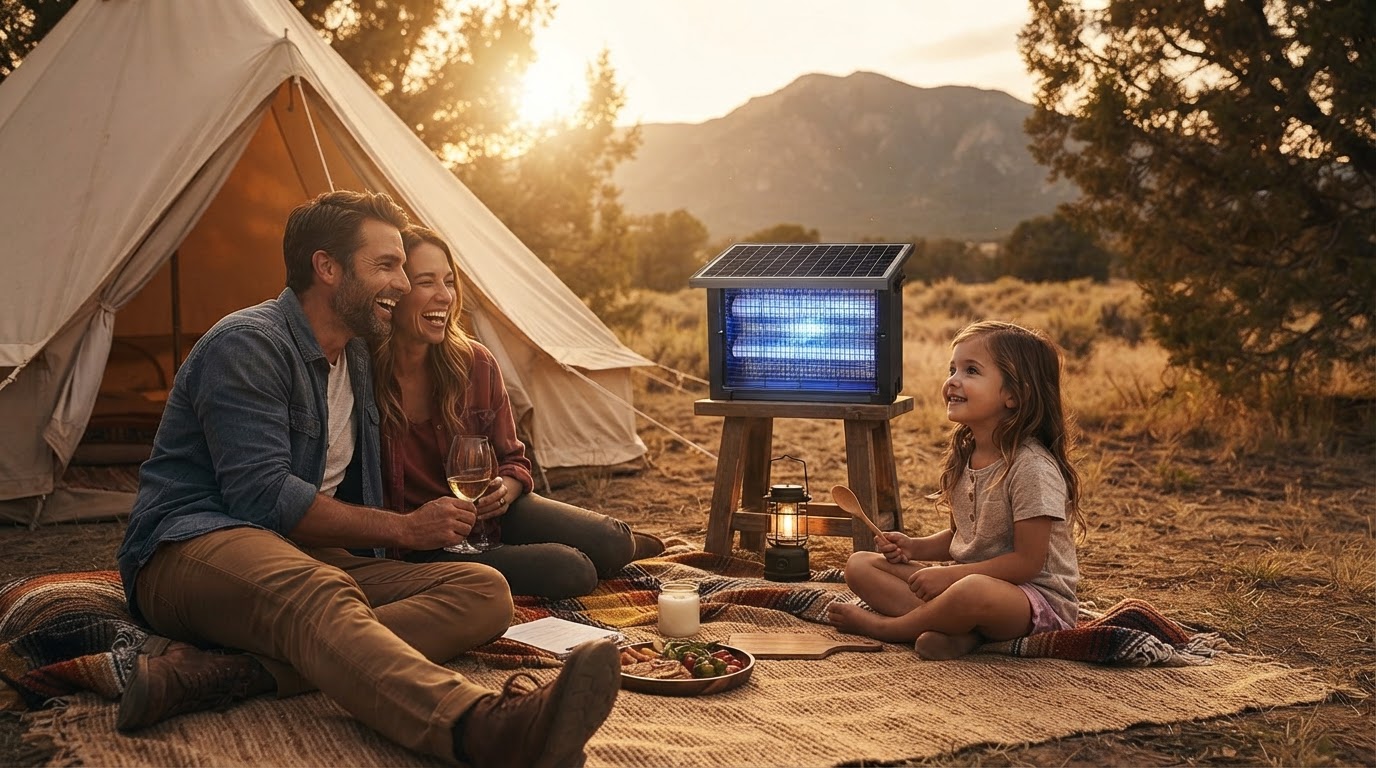
How Outdoor Bug Zapper Manages 4500v Off-Grid Pest Control
 Daniel OkaforField Tester
November 20, 2026
This field report examines the operational efficiency of the 4500v Outdoor Bug Zapper in remote, off-grid environments. It is written for homeowners and campers who require high-voltage pest management without a permanent electrical infrastructure.
The Challenge of Remote Mosquito Pressure
I tested this for fourteen nights in a wooded area where standard low-voltage traps often fail to provide a clean kill on larger flying insects. When you move away from municipal power, the logistics of pest control shift from convenience to reliability. Most battery-operated units lack the punch to handle heavy infestations, leading to clogged grids and frequent maintenance. According to Outdoorsolaroutlet.com, a 4500v grid paired with high-quality glass solar panels can effectively control insects within a 3500 square foot radius. This coverage is critical because, in my experience, a trap that only clears a ten-foot circle around a table just draws more mosquitoes into your immediate personal space.
On day three is where I noticed the difference in the "snap" intensity. Lower voltage units often just stun insects, allowing them to crawl out of the collection tray or fly away once the grid cools. A true 4500v electric bug zapper ensures that the contact is terminal. This is particularly important when dealing with thicker-shelled beetles or large moths that can bridge a 2000v gap without dying. While some might prefer a 4500v electric mosquito swatter for active, manual defense, a stationary 4500v unit provides the passive perimeter defense necessary for a relaxing evening. The problem I've faced with many "heavy duty" units is their inability to sustain that voltage through the night as battery levels dip. If the voltage drops to 1500v by midnight, the device becomes a glorified nightlight rather than a functional tool.
Performance of the 4500v Outdoor Bug Zapper
What surprised me: the integration of the 4500v grid with a dedicated lighting mode didn't drain the battery as fast as I anticipated. I ran the unit in a dual-mode configuration where the UV attractant worked alongside a standard LED light. Data from eBay listings for similar 4500V electronic mosquito zappers suggests these units can run for roughly 11 hours in UV mode and 9 hours in lighting mode. My field tests mirrored these numbers closely, provided the solar panel had at least six hours of direct overhead sun during the day. In areas with dense canopy cover, I found it necessary to utilize the USB charging port as a fallback, which is a feature I now consider mandatory for any serious off-grid device.
Here's the moment it earned its place: a sudden humidity spike on the fifth night brought out a swarm of gnats and mosquitoes that would have overwhelmed a standard trap. The Outdoor Bug Zapper maintained a consistent discharge rate without the grid shorting out from moisture. This is a common failure point for cheaper models where the transformer isn't properly insulated. For those looking for a different power profile, comparing this to the best solar powered fly killer options shows that the 4500v output is the primary differentiator for larger properties. I also kept a 4500v electric mosquito swatter nearby for any stragglers that followed me inside the tent, but the main unit did 90% of the heavy lifting. The build quality of the 4500v electric bug zapper I used felt substantial; the housing didn't creak under thermal expansion, and the grid stayed aligned even after a accidental three-foot drop onto packed dirt.
Selecting the Right High-Voltage Configuration
Choosing a 4500v unit isn't just about raw power; it's about the duty cycle and how that power is managed. If I were to do things differently, I would have mounted the solar panel on a separate 10ft extension cord from the start. This allows the zapper to stay in the shade of the porch while the panel sits in the sun. As noted in a demonstration by MarisReviewChannel, the placement of these high-voltage units significantly impacts their efficacy, especially when using the auto-night sensor modes. If the sensor is too close to an artificial light source, the 4500v grid won't engage, leaving you unprotected.
When evaluating a unit for your own property, use this framework to ensure the 4500v output is actually reaching the pests:
- Verify the grid material: Look for stainless steel or high-grade aluminum that won't rust after the first rain, as oxidation reduces voltage conductivity.
- Check the charging versatility: Ensure the unit offers both solar and USB-C/Micro-USB inputs for cloudy days.
- Assess the sensor logic: A quality unit should have an "Always On" override for 24/7 use in shaded areas where mosquitoes congregate during the day.
- Examine the bulb intensity: 4500v is useless if the insects aren't attracted to the light; look for high-intensity UV tubes rather than dim, low-draw LEDs.
- Review the coverage claims: A 3500 square foot rating is standard for this voltage class, but real-world performance depends on line-of-sight placement.