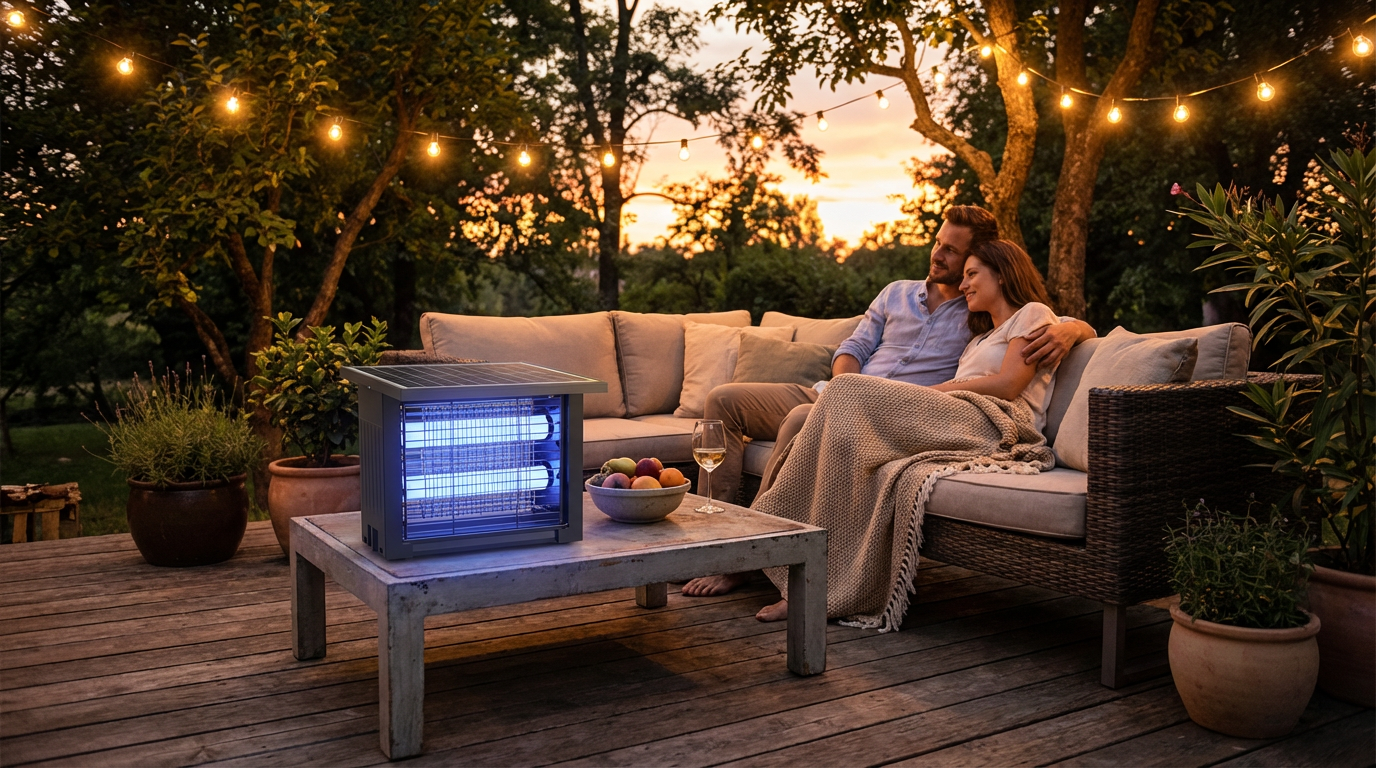
Light Up Your Nights: The Science Behind Bug Zappers
 Daniel OkaforField Tester
The Allure of the Blue Light: How Bug Zappers Work
There's something undeniably satisfying about the distinct "zap" sound from an outdoor bug zapper on a summer evening. But have you ever stopped to wonder about the science working tirelessly behind that glowing blue light? It's more than just a bright bulb; it's a carefully designed system exploiting insect behavior.
At their core, bug zappers, also known as electronic insect killers, use a combination of light attraction and an electrified grid. The light source, typically a fluorescent or LED bulb, emits ultraviolet (UV) light. Many nocturnal insects, including mosquitoes, moths, and various flies, are highly attracted to UV light because it mimics natural light sources they use for navigation and foraging, like the moon. This is a phenomenon known as phototaxis.
The Electrifying Trap: What Happens Next
Photo by Sóc Năng Động on Pexels
Once drawn to the UV light, insects fly towards the source, often through a protective cage. Within this cage lies the lethal component: a pair of high-voltage, low-amperage electrical grids. These grids are separated by a small gap, creating an electrical field between them.
As an insect attempts to fly through this gap, its body completes the circuit between the two grids. This brief contact results in a high-voltage discharge, instantly electrocuting the insect – hence the satisfying "zap." The low amperage ensures that while the shock is powerful enough to kill small insects, it's generally not dangerous to humans or larger animals that might accidentally come into contact with the outer protective cage (though direct contact with the inner grid should always be avoided).
Optimizing for Effectiveness: Beyond the Blue Light
While the basic principle is clear, modern bug zappers often incorporate additional features to enhance their effectiveness. Some models include octenol as an attractant, a chemical compound found in human breath and sweat that is particularly enticing to mosquitoes. Others may vary the light wavelength slightly to target specific pest types.
The placement of your bug zapper also plays a crucial role. For optimal performance, position it away from your primary gathering areas in your yard. This strategy ensures that insects are drawn away from you and your guests, rather than over to your patio. Similarly, avoid placing it too high, as many flying insects prefer to navigate at lower altitudes.
Conclusion: A Scientific Solution to Pesky Pests
Photo by Matheus Bertelli on Pexels
Understanding the science behind outdoor bug zappers enhances our appreciation for these simple yet effective devices. By harnessing the innate attraction of insects to UV light and employing a straightforward electrical principle, bug zappers offer a powerful, chemical-free way to reclaim your outdoor spaces from buzzing intruders. So, the next time you hear that reassuring "zap," you'll know exactly what brilliant science is at work, helping you enjoy a pest-free evening under the stars.