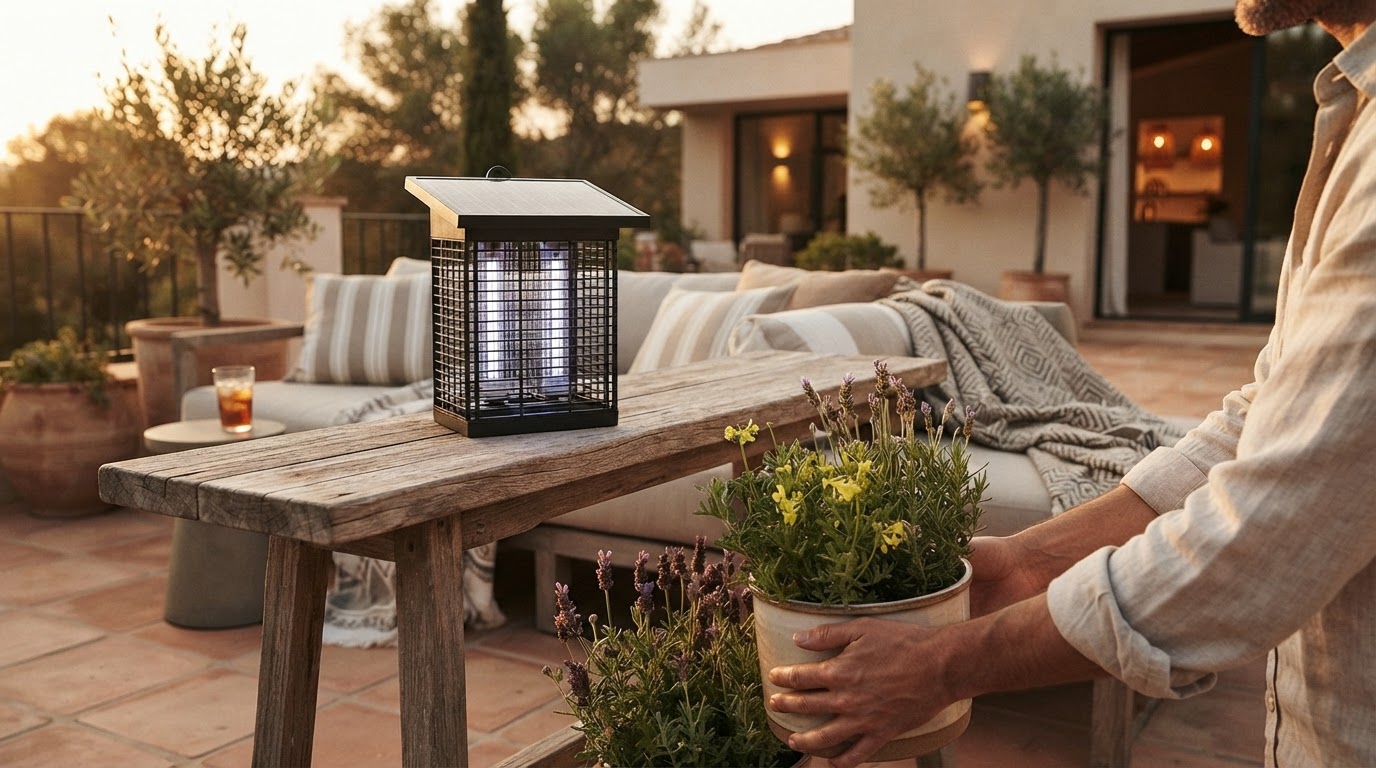
Outdoor Bug Zapper Performance for Patio Pest Control
 Maya ChenContributing Editor
October 23, 2026 — The shift toward off-grid mosquito control devices has accelerated as homeowners seek to eliminate extension cords from their outdoor living spaces, a trend led by the Outdoor Bug Zapper solar series. While many consumers assume solar power equates to lower lethality, recent field assessments suggest that high-voltage capacitor storage is closing the gap between plug-in and cordless units. According to a review by Langy Energy, modern solar zappers utilizing 4500V grids are now providing a practical choice for homeowners who require low-maintenance, high-impact insect management without the constraint of power outlets.
The Off-Grid Efficiency Framework
The conventional wisdom says that solar units lack the raw power to handle heavy-duty mosquito populations, but this ignores the evolution of discharge cycles in modern hardware. Run the math: for a solar device to be effective on a typical residential patio, it must maintain a consistent grid charge through the peak dusk hours when mosquito activity spikes. The Outdoor Bug Zapper 4500V model addresses this by prioritizing grid voltage over auxiliary lighting. While typical retail units struggle with an IP rating that fails under light rain, a robust outdoor bug zapper requires an IP66 or higher rating to survive the humidity levels that actually attract pests. Here’s the part nobody talks about: the efficacy of these devices is almost entirely dependent on the placement relative to ambient light. If your patio has competing LED floodlights, the ultraviolet draw of a solar unit is functionally neutralized. For those maintaining your outdoor bug zapper for off-grid control, the focus should be on maximizing the solar-to-battery conversion rate during the day to ensure the 4500V electric bug zapper has enough stored energy to sustain high-voltage arcs through dawn. In off-grid scenarios, users often mistake a rechargeable camping mosquito lamp for a primary patio solution, but these smaller units lack the surface area of a dedicated solar powered bug zapper outdoor fixture intended for permanent installation.
Expert tip: To optimize the discharge rate, clean the solar panel weekly with a microfiber cloth; even a thin layer of pollen can reduce the charging efficiency by 15%, preventing the capacitor from reaching the full voltage needed for larger flying insects.
I’ll change my mind when a chemical-only solution can demonstrate the same zero-waste profile as a high-voltage solar grid. Until then, the data supports solar-powered electrification as the most sustainable method for long-term patio maintenance.
Sources
- Best Solar Bug Zapper for Backyard Use (2026 Guide) - Langy Energy
- Top 3 BEST Solar Bug Zapper 2026 - YouTube
- Are Solar-Powered Bug Zappers Worth It for Backyard Camping?